interfaces package
Submodules
interfaces.deflationlib module
- interfaces.deflationlib.arnoldi(A, b, x0=None, tol=1e-05, maxiter=1000, inner_m=30)[source]
Computes an orthonormal basis to get the approximated eigenvalues (Ritz eigenvalues) and eigenvector.
The basis comes from a Gram-Schmidt orthonormalization of the Krylov subspace defined as:

at the
 -th iteration.
Parameters
- A : {sparse matrix , linear operator}
matrix we want to approximate eigenvectors;
- b : {array}
array to build the Krylov subspace ;
- x0 : {array}
initial guess vector to compute residuals;
- tol : {float}
tolerance threshold to the Ritz eigenvalue computation;
- maxiter : {int}
to validate the result one can compute maxiter times the eigenvalues, to seek the stability of the algorithm;
- inner_m : {int}
maximum number of iterations within the Arnoldi algorithm,
Warning
inner_m <=N_pix
Returns
- w : {list of arrays}
the orthonormal basis m x N_pix;
- h : {list of arrays}
the elements of the
 Hessenberg matrix.
At the m-th iteration
Hessenberg matrix.
At the m-th iteration  has got
  elements.
- interfaces.deflationlib.build_Z(z, y, w, eps)[source]
Build the deflation matrix
 . Its columns are the
  selected eigenvectors
  s.t. their eigenvalues
  are smaller than a certain threshold eps.
Parameters
- z : {array}
eigenvalues of
;
- y : {list of arrays}
eigenvectors of
;
- w : {list of arrays}
orthonormal basis (computed with the Arnoldi algorithm);
- eps : {float}
threshold to select the smallest eigenvalues.
Returns
- Z : {matrix}
deflation subspace matrix;
- r : {int}
 .
.
interfaces.linearoperators module
- class interfaces.linearoperators.BlockDiagonalLO(CES, n, pol=1)[source]
Bases: linop.linop.LinearOperator
Explicit implementation of
 , in order to save time
in the application of the two matrices onto a vector (in this way the leading dimension will be
, in order to save time
in the application of the two matrices onto a vector (in this way the leading dimension will be  instead of
  ).
).Note
it is initialized as the BlockDiagonalPreconditionerLO since it involves computation with the same matrices.
- class interfaces.linearoperators.BlockDiagonalPreconditionerLO(CES, n, pol=1)[source]
Bases: linop.linop.LinearOperator
Standard preconditioner defined as:

where
 is the pointing matrix (see SparseLO).
Such inverse operator could be easily computed given the structure of the
matrix . It could be sparse in the case of Intensity only analysis (pol=1),
block-sparse if polarization is included (pol=3,2).
is the pointing matrix (see SparseLO).
Such inverse operator could be easily computed given the structure of the
matrix . It could be sparse in the case of Intensity only analysis (pol=1),
block-sparse if polarization is included (pol=3,2).Parameters
- n:{int}
the size of the problem, npix;
- CES:{ProcessTimeSamples}
the linear operator related to the data sample processing. Its members (counts, masks, sine, cosine, etc... ) are needed to explicitly compute the inverse of the
blocks of  .
.
- pol:{int}
the size of each block of the matrix.
 ,
where
,
where  is an
is an - class interfaces.linearoperators.BlockLO(blocksize, t, offdiag=False)[source]
Bases: interfaces.blkop.BlockDiagonalLinearOperator
Derived class from blkop.BlockDiagonalLinearOperator. It basically relies on the definition of a block diagonal operator, composed by nblocks diagonal operators. If it does not have any off-diagonal terms (default case ), each block is a multiple of the identity characterized by the values listed in t and therefore is initialized by the BlockLO.build_blocks() as a linop.DiagonalOperator.
Parameters
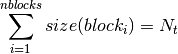
- blocksize : {int or list }
size of each diagonal block, if int it is :
 .
.
- t : {array}
noise values for each block
- offdiag : {bool, default False}
strictly related to the way the array t is passed (see notes ).
Note
- True : t is a list of array,
shape(t)= [nblocks,bandsize], to have a Toeplitz band diagonal operator,

- False : t is an array, shape(t)=[nblocks].
each block is identified by a scalar value in the diagonal.
- build_blocks()[source]
Build each block of the operator either with or without off diagonal terms. Each block is initialized as a Toeplitz (either band or diagonal) linear operator.
- self.diag: {numpy array}
- the array resuming the
 .
.
- class interfaces.linearoperators.CoarseLO(Z, Az, r, apply='LU')[source]
Bases: linop.linop.LinearOperator
This class contains all the operation involving the coarse operator
 .
In this implementation is always applied to a vector wiht
its inverse :
.
In this implementation is always applied to a vector wiht
its inverse :  .
When initialized it performs either an LU or an eigenvalue decomposition
to accelerate the performances of the inversion.
.
When initialized it performs either an LU or an eigenvalue decomposition
to accelerate the performances of the inversion.Parameters
- Z : {np.matrix}
deflation matrix;
- A : {SparseLO}
to compute vectors
 ;
;
- r : {int}
- , dimension of the deflation subspace;
- apply:{str}
- LU: performs LU decomposition,
- eig: compute the eigenvalues and eigenvectors of E.
- mult(v)[source]
Perform the multiplication of the inverse coarse operator
 .
It exploits the LU decomposition of to solve the system
.
It exploits the LU decomposition of to solve the system  .
It first solves
.
It first solves  and then
  .
.
- mult_eig(v)[source]
Matrix vector multiplication with
computed via
setting_inverse_w_eigenvalues().
- class interfaces.linearoperators.DeflationLO(z)[source]
Bases: linop.linop.LinearOperator
This class builds the Deflation operator (and its transpose) from the columns of the matrix Z.
Parameters
- z : {np.matrix}
the deflation matrix. Its columns are read as arrays in a list self.z.
 with
with  .
. .
.- class interfaces.linearoperators.FilterLO(size, subscan_nsample, samples_per_bolopair, bolos_per_ces, pix_samples, poly_order=0)[source]
Bases: linop.linop.LinearOperator
When applied to
vector, this operator filters out
Legendre Polynomial components from it up to a certain order.
In the simple case of a  order polynomial the effectof filter consists of subtracting the offset from the samples.
Parameters
- size: {int}
the size of the input array;
- subscan_nsample: {list of 2 array}
- subscan_nsample[0], contains the size of each chunk of the samples
which has to be processed;
- subscan_nsample[1], contains the starting sample index of each chunk;
- samples_per_bolopair:{list of int }
Number of samples observed during one Constant Elevation Scan (CES) for any pair of detectors. If more CES are included it is a list of int;
- bolos_per_ces:{list of int}
Number of pairs of detectors that observed during a CES.
- pix_samples: {array}
the same argument as in SparseLO, encoding all the pixels observed during observations.
- poly_order: {int}
maximum order of polynomials to be subtracted from the samples.
Note
To be consistent with tha analysis FilterLO does not take into account all the flagged samples.
- class interfaces.linearoperators.InverseLO(A, method=None, preconditioner=None)[source]
Bases: linop.linop.LinearOperator
Construct the inverse operator of a matrix
, as a linear operator.Parameters
- A : {linear operator}
the linear operator of the linear system to invert;
- method : {function }
the method to compute A^-1 (see below);
- P : {linear operator } (optional)
the preconditioner for the computation of the inverse operator.
- converged[source]
provides convergence information:
- 0 : successful exit;
- >0 : convergence to tolerance not achieved, number of iterations;
- <0 : illegal input or breakdown.
- isconverged(info)[source]
It returns a Boolean value depending on the exit status of the solver.
Parameters
- info : {int}
output of the solver method (usually scipy.sparse.cg()).
- method[source]
The method to compute the inverse of A. It can be any scipy.sparse.linalg solver, namely scipy.sparse.linalg.cg(), scipy.sparse.linalg.bicg(), etc.
 by solving the linear system
  with a certain
 - class interfaces.linearoperators.SparseLO(n, m, pix_samples, pol=1, angle_processed=None)[source]
Bases: linop.linop.LinearOperator
Derived class from the one from the LinearOperator in linop. It constitutes an interface for dealing with the projection operator (pointing matrix).
Since this can be represented as a sparse matrix, it is initialized by an array of observed pixels which resembles the (i,j) positions of the non-null elements of the matrix,``obs_pixs``.
Parameters
- n : {int}
size of the pixel domain ;
- m : {int}
size of time domain; (or the non-null elements in a row of
 );
);
- pix_samples : {array}
list of pixels observed in the time domain, (or the non-null elements in a row of
);
- pol : {int,[default pol=1]}
process an intensity only (pol=1), polarization only pol=2 and intensity+polarization map (pol=3);
- angle_processed: {ProcessTimeSamples}
the class (instantiated befor SparseLO)has already computed the
 and
and  , we link the cos and sin
attributes of this class to the ProcessTimeSamples ones ;
, we link the cos and sin
attributes of this class to the ProcessTimeSamples ones ;
- mult(v)[source]
Performs the product of a sparse matrix
 , with
  a numpy array (
 ) .
) .It extracts the components of
corresponding to the non-null elements of the operator.
- mult_iqu(v)[source]
Performs the product of a sparse matrix
, with v a numpy array containing the
three Stokes parameters [IQU] .Note
Compared to the operation mult this routine returns a
-size vector defined as:
with
 is the pixel observed at time
  with polarization angle
 .
.
- mult_qu(v)[source]
Performs
 with being a polarization vector.
The output array will encode a linear combination of the two Stokes
parameters, (whose components are stored contiguously).
with being a polarization vector.
The output array will encode a linear combination of the two Stokes
parameters, (whose components are stored contiguously).
 .
. . The output vector will be a QU-map-like array.
- class interfaces.linearoperators.ToeplitzLO(a, size)[source]
Bases: linop.linop.LinearOperator
Derived Class from a LinearOperator. It exploit the symmetries of an dim x dim Toeplitz matrix. This particular kind of matrices satisfy the following relation:

Therefore, it is enough to initialize A by mean of an array a of size = dim.
Parameters
- a : {array, list}
the array which resembles all the elements of the Toeplitz matrix;
- size : {int}
size of the block.
Module contents
This module contains the 2 main libraries for COSMOMAP2